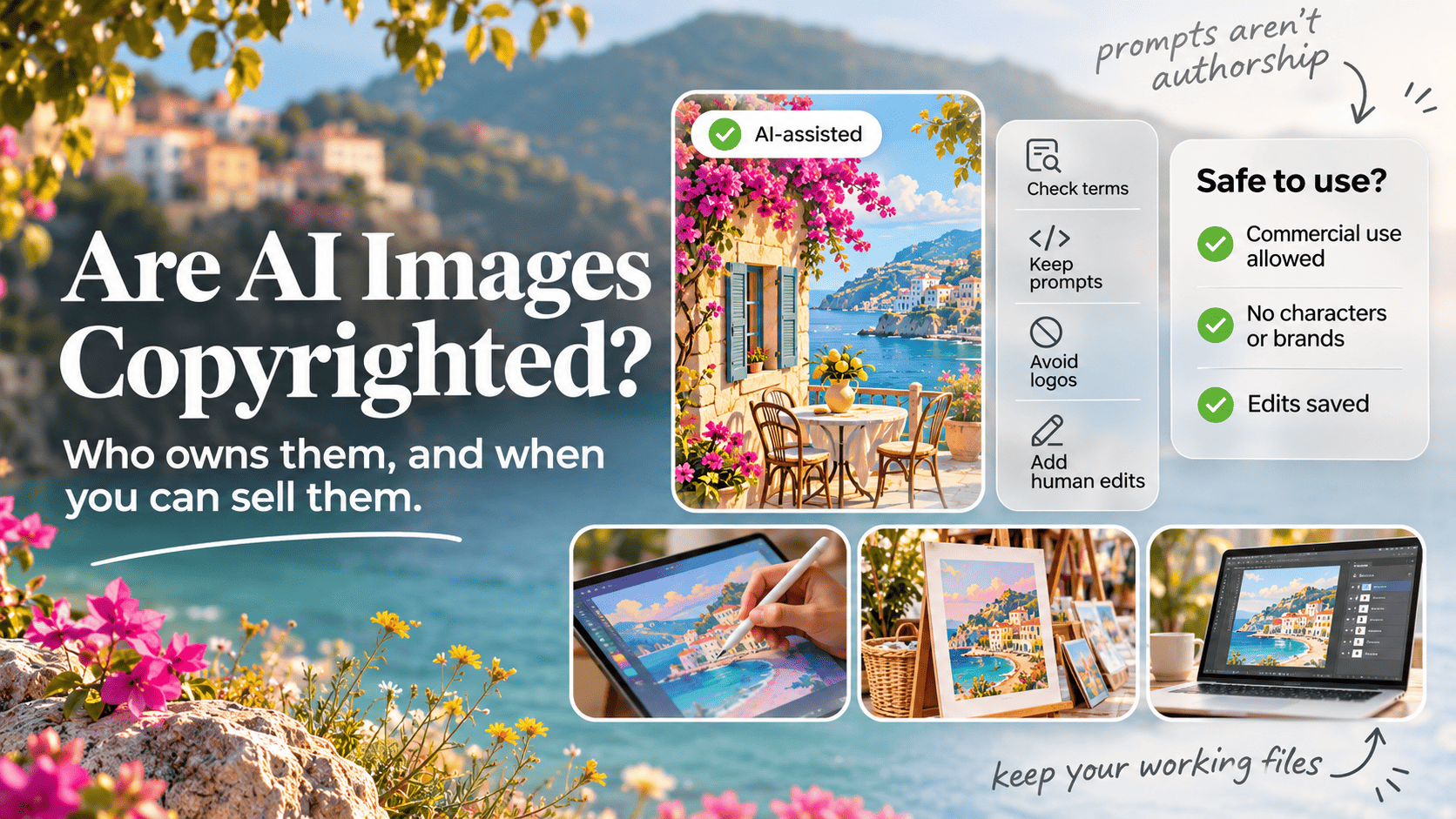
- In the US, an image generated from a prompt alone has no copyright. The Supreme Court declined to hear Thaler v. Perlmutter on 2 March 2026, leaving the human authorship rule in place.
- The UK is the outlier: section 9(3) of the CDPA still protects computer-generated works, but the government's March 2026 report proposes removing that protection. China has protected AI images where the user shows real creative input. Australia and the EU require a human author.
- Commercial use is a separate question, governed by the generator's terms. Midjourney, OpenAI, Google, Stability, Canva and Adobe all let you use output commercially at the time of writing (October 2026), with conditions such as Midjourney's paid-plan rule for companies earning over US$1 million a year.
- Indemnity is rare. Only enterprise, team or API customers of Adobe, Google, OpenAI and Canva get IP protection, and Adobe's standard terms cap it at US$10,000.
- The bigger commercial risks are trademarks, recognisable characters and real people's likenesses. Disney, Universal and Warner Bros. are suing Midjourney over exactly that.
- Keep your prompts and working files. A 2025 Chinese case was lost because the creator couldn't show how she made the image.
Are AI images copyrighted?
Usually not, if a machine made the image from your prompt with little else from you. The US, the EU, Australia and China all require a human author, and the US Copyright Office said in January 2025 that “prompts alone do not provide sufficient human control” to make you the author of the output (US Copyright Office, Part 2 report).
That answer has three important qualifications:
- Human work on top is protected. Text, hand-drawn elements, creative edits and the way you select and arrange AI material can all carry copyright, even when the generated pixels don’t.
- The UK is different. Its 1988 copyright law protects “computer-generated” works, though the government now proposes removing that.
- Other rules still apply. You can still infringe someone else’s copyright or trademark with an AI image, and the generator’s terms still bind you.
The legal position has settled a lot since 2023. The Supreme Court turned down the leading US case on 2 March 2026 (SCOTUSblog), and the UK government published its report on copyright and AI the same month (UK Government, March 2026). What follows is the status in each major jurisdiction as of October 2026, then the commercial-use side.
This is general information, not legal advice. For a specific project, ask a lawyer in your jurisdiction.
United States: human authorship required
US copyright protects only work created by a human. A prompt-only image is in the public domain from the moment it’s made, while the human parts of a mixed work can be registered.
The US position comes from four documents, in this order:
- Registration guidance, 16 March 2023. The Copyright Office told applicants they “have a duty to disclose the inclusion of AI-generated content” and must exclude more than trivial AI material from the claim (Federal Register).
- Zarya of the Dawn, 21 February 2023. Kristina Kashtanova’s comic book kept its registration for the text and for the selection and arrangement of the pages. The Midjourney images themselves were refused because they “are not the product of human authorship” (Copyright Office letter).
- Part 2 of the Copyright and AI report, 29 January 2025. Prompts alone aren’t enough. Where your own artwork is visible in the output, you author that part. Creative selection, coordination, arrangement and modification are protectable. The Office also said no new law or special right is needed.
- Thaler v. Perlmutter. Stephen Thaler tried to register an image his “Creativity Machine” made, naming the machine as author. The DC Circuit held on 18 March 2025 that the Copyright Act “requires all eligible work to be authored in the first instance by a human being” (DC Circuit opinion). The Supreme Court denied review on 2 March 2026 (docket 25-449), so that ruling stands.
The court was careful to say the rule doesn’t block works made with AI. Thaler had listed only the machine as author, so where the human line falls was never tested.
The Copyright Office has started drawing that line in practice. On 30 January 2025 it registered A Single Piece of American Cheese, an image built through many rounds of inpainting on Invoke’s canvas, for the “selection, coordination, and arrangement” of AI-generated material, while excluding the individual generated parts (IPKat). By April 2026 the Office said it had registered more than 6,000 works that include AI-generated material (Law360, April 2026).
Rule of thumb: In the US, ask “which parts did a person decide?” Those parts can be protected. Anything the model decided can’t.
The Office’s AI initiative page still lists Part 3, on training, as a May 2025 pre-publication version, with no final release at the time of writing.
United Kingdom: computer-generated works, for now
The UK is the one major market whose statute protects purely machine-made works. That protection is under review, and the government has said it would rather remove it.
Section 9(3) of the Copyright, Designs and Patents Act 1988 says the author of a computer-generated work is “the person by whom the arrangements necessary for the creation of the work are undertaken”. Section 178 defines computer-generated as made “in circumstances such that there is no human author”. Protection lasts 50 years from the end of the year the work was made, shorter than the usual life-plus-70 term.
Nobody knows how well this fits modern generators. A UK work also has to be original, and current originality tests look for an author’s own creative choices, which is hard to square with a work that by definition has no human author.
The government’s Report on Copyright and Artificial Intelligence, laid before Parliament in March 2026, drew on 11,520 consultation responses. It says most respondents to the question thought works created solely by AI should not be protected. The government proposes to keep monitoring and, “in the absence of evidence of its ongoing value”, remove protection for wholly computer-generated works while keeping it for AI-assisted work. The report also dropped the commercial text and data mining exception it had first preferred, which only 3% of respondents supported (IPKat, March 2026).
Watch out: Section 9(3) is still law as of October 2026, but don’t base a commercial plan on it. The government has said it intends to remove it, and no court has yet confirmed it applies to a text-to-image output.
European Union: originality needs a human
EU law has no AI-specific authorship rule. Copyright protects a work that is the author’s own intellectual creation, a test the Court of Justice built from Infopaq (C-5/08) onwards, and it assumes free, creative choices by a person.
The first court in Europe to apply this to a generated image was the Prague Municipal Court, in a ruling reported in 2024. It held that an image made with a text-to-image model wasn’t protected because it wasn’t the creative product of a natural person, and that the prompt was only an idea or theme (Bird & Bird). The claimant also couldn’t prove his prompt produced the image, which is a recurring theme in these cases.
Three developments to know:
- The Voss report. On 10 March 2026 the European Parliament adopted an own-initiative report on copyright and generative AI. It isn’t binding. Its few paragraphs on output call for a general labelling requirement for purely AI-generated content (Kluwer Copyright Blog).
- Like Company v Google (C-250/25). The first AI copyright referral to the Court of Justice asks about training and chatbot outputs, not authorship. A ruling is unlikely before 2027 (Stephenson Harwood).
- AI Act Article 50. Since 2 August 2026, generative AI providers must mark output as machine-readable AI content, and deployers must disclose deepfakes (Baker Botts). That’s a transparency rule, separate from copyright.
China: protected if you can show your input
China is the jurisdiction most willing to protect AI images, but only when the user proves real creative input.
In Li v Liu, decided on 27 November 2023 ((2023) Jing 0491 Min Chu No. 11279), the Beijing Internet Court held that an image Li made with Stable Diffusion was a protected work and that Li was its author (judgment and translation). Li had selected and arranged more than 150 prompts and kept adjusting parameters until the output matched his idea. The AI couldn’t be an author, and neither could its developers (Kluwer Copyright Blog).
A 2025 case shows the other side. In Feng v. Zhangjiagang Dongshan Culture Communication, the court dismissed all claims. It said images made mainly from a simple prompt generally aren’t works, and that AI-assisted images need proof of original input. Feng hadn’t kept records of her process, and the image she tried to reproduce at the hearing looked significantly different from the disputed one (Legal 500).
Common mistake: Deleting your working files. Every court that has looked at AI-assisted images, in China, Prague and the US Copyright Office, has asked what the human did. Prompts, seeds, version history and layered files are your evidence.
Australia: no AI rule, human author needed
Australia’s Copyright Act 1968 has no computer-generated works provision, and case law requires a human author. A purely AI-generated image almost certainly has no copyright in Australia.
The key authority is Telstra v Phone Directories, decided by the Full Federal Court on 15 December 2010. Telstra’s White and Yellow Pages weren’t protected because, as Keane CJ put it, compiling them “was overwhelmingly the work of the Genesis Computer System” (Federal Court judgment). No Australian court has yet ruled on a generated image, so how much human input is enough remains untested.
Government action has focused on training, not ownership:
- October 2025: Attorney-General Michelle Rowland ruled out a text and data mining exception for AI training. The Copyright and AI Reference Group was asked to look at licensing pathways, a possible small claims forum, and how copyright applies to “material generated through the use of AI” (Attorney-General; iTnews, 27 October 2025).
- July 2026: The Prime Minister said no company should use Australian creative work to train AI “without the artist’s control”, alongside plans for national AI standards, with legislation expected in 2027 (International Bar Association, October 2026).
No reform of authorship for AI output has been announced at the time of writing.
Status by jurisdiction (October 2026)
| Jurisdiction | Prompt-only image | AI-assisted work | Latest development |
|---|---|---|---|
| United States | No copyright | Human parts protected | Cert denied in Thaler, 2 Mar 2026 |
| United Kingdom | Protected under s9(3), 50 years | Protected | Government proposes removal, Mar 2026 |
| European Union | Not protected | Protected if author’s own creation | Voss report adopted, 10 Mar 2026 |
| China | Generally not | Protected with proof of input | Feng dismissed for lack of records, 2025 |
| Australia | Almost certainly not | Untested, human author needed | TDM exception ruled out, Oct 2025 |
Can you use AI images commercially?
Yes, in most cases. Whether you may use an image commercially is set by the generator’s terms, and copyright status doesn’t change that. Every major tool we checked allows commercial use of output, but the conditions, ownership wording and protection vary a lot.
We read each provider’s current terms in October 2026:
| Generator | Who owns output | Commercial use | Paid plan needed? | IP indemnity |
|---|---|---|---|---|
| Midjourney | You, “to the fullest extent possible” | Yes | Pro or Mega if your company earns over US$1M/yr | None; you indemnify Midjourney |
| OpenAI (ChatGPT, API) | Assigned to you | Yes | No | API and ChatGPT Enterprise only |
| Adobe Firefly | Your content | Yes | No (free plan exists) | Eligible team and enterprise plans |
| Google (Gemini, Imagen) | Google “won’t claim ownership” | Yes | No | Paid Cloud and Workspace only |
| Stability AI | You | Yes | Enterprise licence over US$1M revenue | None in Community Licence |
| Canva | You, unless it incorporates Canva library content | Yes, any lawful purpose | No | Enterprise (Canva Shield) |
| Getty Images AI | Not stated; not licensed to others | Yes | Yes | Up to US$50,000 per image |
The details that change real decisions:
- Midjourney (terms effective 27 May 2026) says a company or employee of a company with more than US$1,000,000 in annual revenue “must be subscribed to a ‘Pro’ or ‘Mega’ plan to own Your Assets”. Ownership is also “subject to… the rights of any third-parties”, and Midjourney gets a perpetual licence to what you make.
- OpenAI “hereby assigns to you all its right, title and interest in and to Output”, subject to following the terms. Its IP indemnity sits in the Service Terms and covers API and ChatGPT Enterprise customers only.
- Adobe says Firefly output “can be used for commercial purposes”, and its June 2025 generative AI terms warn that output “may not be protectable by Intellectual Property Rights”. Partner models such as Google’s and OpenAI’s inside Firefly are excluded from the Firefly indemnity and covered only by narrower supplemental terms from 8 May 2026 (Adobe).
- Google consumer terms (effective 30 July 2026) say Google won’t claim ownership of generated content. The output indemnity applies to generally available Imagen and Gemini models through Google Cloud, plus Gemini in Workspace.
- Stability AI’s Community Licence is free for individuals and businesses under US$1 million in annual revenue, counted “regardless of the source”. Above that you need an Enterprise licence.
- Canva’s AI Product Terms (effective 26 June 2026) say you own your output “except for any Output that modifies or incorporates Licensed Content”, and other users may get similar output. Canva Shield’s indemnity, announced in October 2023, covers enterprise customers (SmartCompany).
Worth knowing: “You own the output” in a generator’s terms only means the provider won’t claim it. It can’t give you copyright the law doesn’t recognise. Adobe and Canva both say as much in their own terms.
What indemnity actually covers
An indemnity means the provider defends you, and pays, if someone claims your generated image infringes their IP. It’s the strongest protection on offer, and most people don’t have it.
| Provider | Who’s covered | Notable limits |
|---|---|---|
| Adobe Firefly | Eligible teams and enterprise plans | Standard terms cap at US$10,000; partner models excluded |
| Google Cloud | Paid GA Imagen, Gemini via Cloud; Gemini in Workspace | Generally available models only; not free consumer tools |
| OpenAI | API and ChatGPT Enterprise | Not if you knew output was infringing; not modified output; not trademark use in commerce |
| Canva | Enterprise customers | Not Free, Pro or Teams plans |
| Getty Images | Generator subscribers | Up to US$50,000 per image; uncapped on enterprise plans |
Sources: Adobe terms, Google Cloud, OpenAI Service Terms, Getty Images.
OpenAI’s exclusions are typical. Cover disappears if you “knew or should have known” the output was infringing, disabled safety features, modified the output or combined it with other products, or face a trademark claim from using the output “in trade or commerce”. Since most commercial use involves editing an image and putting it in a design, read the modification clause carefully.
Legal risks beyond copyright
Whether you own an AI image matters less, commercially, than whether it infringes someone else’s rights. That risk comes from training data, from recognisable characters and brands, and from real people’s faces.
Training-data lawsuits
These cases are about how the models were built. A ruling against a provider wouldn’t automatically make your existing images infringing, but it could change what tools are available and what they’ll generate.
- Getty Images v Stability AI (UK). On 4 November 2025 the High Court ([2025] EWHC 2863 (Ch)) rejected Getty’s secondary copyright claim. Getty had accepted that Stable Diffusion’s model weights contain no copies of its images, and the judge held that an “infringing copy” must at some point have contained a copy (Judiciary). Getty won only an “extremely limited” trademark point over watermark-like marks in outputs from early model versions (Bird & Bird). Getty dropped its main training claim because training happened outside the UK. Permission to appeal the secondary infringement point was granted on 16 December 2025 (Chambers), and we found no Court of Appeal decision at the time of writing.
- Andersen v. Stability AI (US). Artists sued Stability, Midjourney, DeviantArt and Runway. On 12 August 2024 Judge Orrick let the direct and induced copyright claims and the trademark claims proceed (Copyright Alliance). The schedule has since slipped twice in 2026, and summary judgment now looks unlikely before late 2027 (case tracker).
- Disney and Universal v. Midjourney (US). Filed in June 2025 in the Central District of California (Law360), the studios call Midjourney “a bottomless pit of plagiarism” and point to outputs of characters from Star Wars, The Simpsons and Shrek (NBC News). Warner Bros. Discovery filed a related suit on 4 September 2025 over Superman, Batman and Scooby-Doo (Claims Journal). As of October 2026 the case is in discovery, with Midjourney’s July 2026 motion for judgment on the pleadings still undecided (case tracker).
Trademarks, characters, likeness and style
Most real disputes over AI images in marketing start here. A generator will often happily produce a recognisable character, a logo-like mark or a celebrity’s face, and none of the commercial-use clauses above protect you from that.
| Risk | Example | Why it matters |
|---|---|---|
| Characters | A cartoon mouse in red shorts | Copyright and trademark in the character, regardless of who drew it |
| Logos and marks | A sneaker with a familiar swoosh | Trademark infringement and passing off |
| Real people | A “customer” who looks like a celebrity | Publicity rights and false endorsement claims |
| Watermarks | Stray stock-agency marks | The trademark issue Getty won in the UK |
| Named-artist styles | “In the style of” a living illustrator | Style itself isn’t protected, but it’s part of the Andersen dispute |
Prompting for a franchise character is the clearest case of risk. OpenAI’s indemnity excludes output you “should have known” was infringing, and typing a character’s name is hard to explain later.
Platform and disclosure rules
Even where AI images are legal, platforms set their own rules:
- YouTube requires creators to disclose realistic AI-generated or altered content, such as a scene that didn’t happen or a real person doing something they didn’t. Clearly unrealistic content and beauty filters are exempt (YouTube Help).
- Meta labels AI content on Facebook and Instagram using industry signals and self-disclosure, and renamed its label “AI info” in July 2024 (Meta).
- Canva’s AI terms forbid using its tools to mislead anyone that AI content is human-made, and forbid stripping C2PA provenance data.
- EU AI Act rules on deepfake disclosure apply from 2 August 2026, as above.
Provenance data matters beyond compliance. As an AI SEO consultant in Melbourne, Saijo George sees AI answer engines leaning on pages with clear, verifiable sourcing, and honest labelling of generated images is part of that.
Safe commercial use checklist
Run through this before an AI image goes into an ad, product, client deliverable or anything you sell.
| Check | What to do |
|---|---|
| Plan terms | Confirm your plan allows commercial use and ownership (Midjourney over US$1M, Stability over US$1M) |
| Prompt hygiene | No brand names, characters, real people or living artists’ names |
| Output review | Zoom in for logos, watermarks, stray lettering or faces you recognise |
| Reverse search | Run the image through a reverse search to catch near-copies of real works |
| Add human work | Edit, composite or redraw if you need copyright in the result |
| Keep records | Save prompts, seeds, versions and layered files with dates |
| Contracts | Don’t warrant copyright you can’t give; disclose AI use to clients |
| Disclosure | Label realistic AI images where platforms or law require it |
| High stakes | Use an indemnified enterprise tool or licensed human-made stock |
Quick check: If a client contract says you “assign all copyright” in the deliverables, a prompt-only image may not have any to assign. Change the clause or change the image.
For logos, packaging and anything you’ll want to stop competitors copying, the safest route is still human-authored work, or AI used only as a sketch that a designer then redraws.
When free stock is the safer choice
For many commercial jobs, a licensed human-made photo beats a generated one on legal certainty. The photographer holds copyright, the licence tells you exactly what you can do, and there’s no question about training data or hidden likenesses.
Free stock libraries cover most everyday needs: team and workplace scenes, products in use, landscapes and textures. Our guide to free stock images and videos you can use commercially without a watermark lists the sites with the cleanest terms, and our explainer on free stock photo licences covers what each licence type allows. If you specifically need to avoid generated content, here’s how to find stock photos that aren’t AI-generated.
AI images make most sense for concept art, abstract backgrounds, mock-ups and illustrations no stock library has. Real photography makes more sense for anything that says “this is us” or “this happened”. Our free stock directory notes which sites ban AI uploads and which label them, so you can pick the right source for each job.
Questions you may have
Can I sell AI-generated art on Etsy or Redbubble?
Usually yes, if the generator's terms allow commercial use and the image doesn't copy a protected character, logo or artwork. Check the marketplace's own rules too, since several print-on-demand and craft sites have their own AI policies. Remember that without copyright you can't stop someone else selling the same design. If a print takes off, the only thing protecting you is speed and brand, so adding your own illustration, typography or layout gives you something you can actually defend.
Can I trademark a logo made with AI?
Trademark and copyright are separate systems. A trademark protects a sign used in trade, and registries don't ask whether a human drew it. The weak point is copyright: if the logo has none, a competitor could copy the artwork in a non-trademark context, and anyone could claim your generator made similar output for them. For a logo, use AI for ideas, then have a designer redraw it so the final mark has a human author and a clean file history.
Do I need to tell clients I used AI images?
There's no general legal duty in most countries, but many contracts now include one. Check the brief for an AI clause and any warranty that deliverables are original or copyrightable. Since US law won't protect a prompt-only image, telling a client you're assigning them copyright in it could be a misstatement. A one-line disclosure in the delivery note costs nothing and avoids that problem.
Is it legal to use AI images on my business website in Australia?
Yes. Nothing in Australian law bans it, and the Copyright Act 1968 contains no AI-specific rules at the time of writing. The usual limits apply: the image can't reproduce someone else's protected work, can't suggest a false endorsement, and can't mislead customers about your products. A generated photo of a product you don't sell, or a team page of generated people, is where trouble starts.
Can someone else use the AI image I generated?
If the image has no copyright, copying it isn't infringement in the US, and probably not in Australia or the EU either. Your generator's terms only bind you and the provider, so they can't stop a stranger. Some tools also state outright that other users may get similar output. Canva's AI terms say so directly. The practical fix is to combine generated elements with your own work, which gives you copyright in the combined piece.
Does editing an AI image in Photoshop make it copyrighted?
It can, for the parts you change. The US Copyright Office's January 2025 report says human authors are entitled to protection for creative modifications and for the selection and arrangement of AI material, while the generated pixels themselves stay unprotected. Small fixes like colour correction or cropping won't be enough. Repainting, compositing several elements and adding hand-drawn work are the kinds of changes that count.
Are images from free AI generators safe to use commercially?
Free tiers vary more than paid ones. Stability's Community License allows free commercial use only for individuals and businesses under US$1 million in annual revenue, and Midjourney requires a Pro or Mega plan for larger companies to own their output. No free plan we checked includes an IP indemnity. For low-risk decorative use a free tool is usually fine; for packaging, ads or client work, read the plan terms first.
Can I use an AI image that copies a famous photographer's style?
Copyright protects specific expression, not style, so an image that only shares a look is generally lawful. The risk rises when the output reproduces recognisable elements of a real image, or when you name the artist in marketing. In Andersen v. Stability AI, artists whose names are used as style prompts are suing, and the court let their copyright and trademark claims proceed in August 2024. Avoid artist names in prompts for commercial work.
What happens if my AI image turns out to infringe?
The rights holder can ask you to take it down, claim damages, and in the US seek statutory damages for registered works. Most generators make you indemnify them, so the cost sits with you unless you have an enterprise indemnity. Act quickly on any notice: OpenAI's indemnity excludes claims where you "knew or should have known" the output was infringing (OpenAI Service Terms), so carrying on after a complaint weakens any cover you have.
Sources
- US Copyright Office (2025): Copyright and Artificial Intelligence, Part 2: Copyrightabilitycopyright.gov
- SCOTUSblog: Thaler v. Perlmutter, No. 25-449scotusblog.com
- UK Government (2026): Report on Copyright and Artificial Intelligenceassets.publishing.service.gov.uk
- Federal Register (2023): Copyright Registration Guidance, Works Containing Material Generated by AIfederalregister.gov
- US Copyright Office (2023): Zarya of the Dawn registration decision lettercopyright.gov
- US Court of Appeals, DC Circuit (2025): Thaler v. Perlmutter, No. 23-5233 (Justia)law.justia.com
- IPKat (2025): A Single Piece of American Cheese registrationipkitten.blogspot.com
- Law360 (2026): Copyright head touts 6,000 registrations of human-AI workslaw360.com
- US Copyright Office: Copyright and Artificial Intelligence initiativecopyright.gov
- legislation.gov.uk: Copyright, Designs and Patents Act 1988, section 9legislation.gov.uk
- legislation.gov.uk: Copyright, Designs and Patents Act 1988, section 178legislation.gov.uk
- IPKat (2026): UK Report on Copyright and Artificial Intelligence publishedipkitten.blogspot.com
- EUR-Lex (2009): Infopaq International v Danske Dagblades Forening, Case C-5/08eur-lex.europa.eu
- Bird & Bird (2024): Czech court denies copyright protection of AI-generated workcm.twobirds.com
- Kluwer Copyright Blog (2026): The European Parliament adopts the Voss report on copyright and generative AIlegalblogs.wolterskluwer.com
- Stephenson Harwood (2025): CJEU to rule on AI and copyright in Like Company v Google (C-250/25)stephensonharwood.com
- Baker Botts (2026): EU AI Act Article 50 transparency obligations go livebakerbotts.com
- Internet Archive: Li v Liu, Beijing Internet Court (2023), with English translationarchive.org
- Kluwer Copyright Blog (2024): Beijing Internet Court grants copyright to AI-generated imagelegalblogs.wolterskluwer.com
- Legal 500 (2025): AI-generated content, Chinese courts' shifting views on copyrightlegal500.com
- Federal Court of Australia (2010): Telstra Corporation Ltd v Phone Directories Company Pty Ltd [2010] FCAFC 149judgments.fedcourt.gov.au
- Federal Register of Legislation: Copyright Act 1968 (Cth)legislation.gov.au
- Attorney-General (2025): Albanese Government to ensure Australia is prepared for future copyright challenges emerging from AIministers.ag.gov.au
- iTnews (2025): Government rules out AI training exemption in copyright lawsitnews.com.au
- International Bar Association (2026): Artificial intelligence and copyright in Australiaibanet.org
- Midjourney: Terms of Servicedocs.midjourney.com
- OpenAI: Terms of Useopenai.com
- OpenAI: Service Termsopenai.com
- Adobe: Firefly plans and commercial useadobe.com
- Adobe (2025): Generative AI Product Specific Termswwwimages2.adobe.com
- Adobe (2026): Creative Partner Models product descriptionhelpx.adobe.com
- Google: Terms of Servicepolicies.google.com
- Google Cloud: Generative AI indemnified servicescloud.google.com
- Stability AI: Licence (Community and Enterprise)stability.ai
- Canva: AI Product Termscanva.com
- SmartCompany (2023): Canva Shield and indemnity for enterprise customerssmartcompany.com.au
- Getty Images: About the Getty Images AI generatorgettyimages.com
- Google Cloud (2023): Protecting customers with generative AI indemnificationcloud.google.com
- Judiciary of England and Wales (2025): Getty Images v Stability AI [2025] EWHC 2863 (Ch)judiciary.uk
- Bird & Bird (2025): Stability AI defeats Getty Images copyright claimscm.twobirds.com
- Chambers (2026): Copyright and AI remain in focus for 2026 with Getty appeal given the green lightchambers.com
- Copyright Alliance (2024): Top takeaways from the order in Andersen v. Stability AIcopyrightalliance.org
- ChatGPT Is Eating the World: Andersen v. Stability AI case updateschatgptiseatingtheworld.com
- Law360: Disney Enterprises Inc. v. Midjourney Inc., 2:25-cv-05275law360.com
- NBC News (2025): Disney and Universal sue AI image company Midjourneynbcnews.com
- Claims Journal (2025): Warner Bros. Discovery sues Midjourneyamp.claimsjournal.com
- ChatGPT Is Eating the World: Disney v. Midjourney case updateschatgptiseatingtheworld.com
- YouTube Help: Disclosing altered or synthetic contentsupport.google.com
- Meta (2024): Our approach to labelling AI-generated content and manipulated mediaabout.fb.com